Showing posts with label Homework and Research. Show all posts

Sunday, 17 February 2013

Credits and Titles: True Blood and Misfits

I have analysed to title sequences from two television programmes and how they reflect the genre of the show. Titles are shown in both of the shows in a certain order, and often only feature the most important members of the crew.

          True Blood:
  • The True Blood titles start with the names of the stars.
  • The titles appear on a different part of the screen as a different name comes up.
  • The titles look handwritten, they are not orderly or conventional, which indicates the horror genre of the programme. 
  • The titles are shown in the order of: Casting, Music, Editing, Production Design, Photography, Producer, Production Company and the Creator.
  • The titles are surrounded by people acting spontaneously and suspiciously, which is parallel to the title and the programme, such as a very unique church pastor and a decomposing dead fox.
  • The titles are white: which symbolise purity and innocence.
  • The "True Blood" sign wiggles and flashes on a red, blood like looking background without footage or action. 
  • The entire sequence in one and a half minutes.


          Misfits:
  • Like True Blood it has it's own title sequence. 
  • There is use of both black and white writing which is in the form of graffiti, links to the grimy setting of the show and title sequence.
  • Letters of the title a jumbled up before they become clearer, this suggests the characters involved in the show, who are "MisFits". The titles look as it they have been written on paper, or scirbbled down quickly, as if there is no thought or perfection behind them, like those involved in the story.
  • Most of the title sequence is in black and white and so are the titles.
  • The names of the stars appear before anything else. 
  • There is action behind the titles, like in True Blood, however the name of the show is on it's own background with no action with what looks like a grey wall behind it. The font stands out: it is very bold black writing.
  • The entire sequence lasts around the same as the True Blood one.
     

It is important that title sequences and credits fit the genre of the programme or film. This research has enabled me to understand that for my own opening sequence it is important to create credits which fit the mood and setting of my opening sequence.

Sound: Speed

The sound from Speed, another thriller is to set a certain atmosphere and mood. The beginning starts with 20th Century Fox sequence, showcasing the institution behind the film. 
The start of the opening begins with the sound of a lift, which could be diegetic. The eery orchestral music featured us non-diegetic to create a tense atmosphere amongst the audience. This sound is parallel to the visual shown. The "Speed" title, as it quickly exits the screen, and with it is matching sound. The pace of the music gets quicker, and builds tension for the audience however as it slows down the mood becomes suspicious. There is no speech throughout the opening, with the only character to appear opening a door, with the sound being diegetic. 

Research into Similar Media Texts


This opening sequence comes from the film "Children of Men". 

  • The Universal Studios sequence appears at the beginning of the film, Universal studios are both producers and distributors so we understand what institutions are involved in the making of this film.
  • There is a black screen for the titles: however the sound we hear, is the news, presumably which is non-diegetic.
  • The opening shot is a medium shot, taken from over head, of a group of ordinary people in a coffee shop- we are given no introduction the main character at first. However there is a close up shot of a male in the coffee shop, which indicates he is the protagonist. 
  • Mise-en-scene: is ordinary clothing. This indicates those involved in the film are "ordinary people". It could also indicate the genre: it eliminates fantasy, fairy tale (which usually uses cartoon characters) etc...
  • The tracking of the male from the coffee shop to outside allows a panning shot of a bleak London, which we know through the red bus, and the title along the bottom telling the audience of the location. There is also indication that this is set in the future, with moving bus advertisements.
  • The music in the opening sequence is quite orchestral and reflective, gives a sense of something tragic.
  • The music, lighting, and the narrative indicate the mood of the film, which is mourning and tense. 
  • The lighting in the entire opening sequence is very dim and full of greys, blacks and white, there is a lot of pollution on the street which makes the setting look very unpleasant and boring.
  • Characterisation: the main character seems to be very serious, middle aged white male. Males usually dominate thrillers. 
  • Narrative: the narrative of Children of Men seems very easy to follow, there has been a killing of the youngest human on the planet. This adds a sense of enigma to the plot, as to why someone who is an adult is the youngest person on the planet. 
  • Representation: Children of Men is very generic of thrillers, using a white male as it's main protagonist. Females do no feature heavily, apart from the fact that they may be portrayed as being more emotional, with more of them crying than males. 
  • As there is a bomb explosion there is a piercing sound of what sounds like a female screaming. The camera's sudden movements indicates the intense and frantic situation of those involved. There is then a silence before the black screen with the title of the film, "Children of Men". The titles in this film do not move, and are black, plain writing.

Friday, 1 February 2013

Initial Planning: Risk Assessment

Whilst initially planning the filming, we conducted a risk assessment to ensure that we understood some of the risks which may take place whilst shooting. Here is the risks we listed that may occur:

1)
Be careful to not burn our hands whilst using the cameras as they may get hot quickly.
2)
Do not drop the camera.
3)
Do not eat or drink near any of the equipment.
4)
Be careful to not trip up over the wires.

Thursday, 31 January 2013

Distributing our Film

It is important to think about who would distribute our film once it is completed. There are many British film distributors however there are some which specialize in certain genres. I have decided to focus on two distributors in particular: Entertainment Film Distributors and Arrow Films.


Applying Narrative Theories to our Opening Sequence

I have previously researched the theories of Propp, Todorov and Strauss and found that their theories fit the vast majority of professional films. It is evident that their theories also fit our opening sequence, I have found whilst planning, shooting and editing the film.


Group Discussions 31/01/13

Today in the lesson Kiah, Laura and I experimented with the software, Live Type, and tried to create what the titles may look like on our opening sequence. This was useful as it familiarized us with this new programme, and it helped us understand what our titles may look like. 
We also decided the name of our opening sequence, would be "Abduction". After doing some editing, we also showed our progress so far to three other non-media students, who gave us feedback, and told us that they thought we had so far created a good opening sequence and had created a clear narrative.

Monday, 28 January 2013

Max Payne Sound Analysis

SHOT NUMBER
SOUND DESCRIPTION
EFFECT
1
20th century Fox theme tune
The 20th century fox theme tune is well know and the audience will be able to recognise this.
2
The sound of someone talking. There is nothing visual at this moment, only a black screen so we are unable to see who is talking.
This can be used to create suspicion. By only having dialogue and no picture this can make the audience feel dark and nervy as the opening picture and introduction to the film only contains suspicious talking.
3
The next sound that is heard is of who we suppose is the protagonist burst out of the water. We can hear his gasps for breath and almost desperation.
The sound of the man gasping for air is diegetic however could have been enhanced to add more effect.
The effect of bursting out of the water is to primarily shock the audience. This is the opening scene and this would cause the audience to feel uncertainty due to the fleeting nature of the shot.
4
The sound heard when the character goes back underwater is non-diegetic in order to create a dark and eerie atmosphere.
The male is stirring: this could have possibly been used to make the audience feel a sense of desperation for him as he struggles. This is also used to cause frustration.
5
The sound of the splashes has been used again to demonstrate the character’s frustration as he struggles. The sound of splashing is on screen diegetic.

The effect created by the sound of splashing is racy and this has been used in order to create frustration and almost agitation amongst the audience as to why he is in this situation. The nervy atmosphere is created through the male’s gasps and continuous splashes.
6
The sound we hear is almost like sonar to show possibly how far underwater they are, especially as the shot is taken almost at an angle where the camera is pointing upwards suggesting how far underwater they are. This sound is non-diegetic as it was most probably not part of the film world.
The use of the sonar effect under the water has been used and creates an eerie and fleeting effect which leaves the audience in suspicious.
7
The noise we can hear is the sonar effect again, which is parallel to the visuals. We can also hear the character speaking slowly.
The effect of the pensive sound is to create a dark and mysterious atmosphere.
8
There is the small sound of the sonar again, as well as a baby crying, this sound would be non-diegetic sound.
The sound of baby crying is eerie, makes the atmosphere suspicious. The sound of crying sounds innocent, which could leave the audience questioning why this man is involved with the child.
9
There is a sound bridge as the sound of the baby crying is carried through from the previous shot.
The repetition is often used for emphasis and that something bad may happen.
10
The narration is non-diegetic however is parallel with what is being shown. The music in the background is also non-diegetic.
The music is used to create curiosity and is pensive so therefore makes the audience apprehensive.
11
The creaking door is non-diegetic and is parallel to the visual shown. The creaking door is used to add a scary effect.

The effect that is intended is suspicion as creaking doors often are connected to horror films. There is a dark atmosphere created.
12
The chimes in the background are non-diegetic and creates a dark atmosphere. The sound is slightly contrapuntal due to the fact that chimes are usually associated with relaxation and the visual shows a woman who may/may not be dead.
The sound of the chimes used are made to create an eerie and mysterious effect due to the fact there is a woman who could have died.
13
The sound of the clock ticking and the chimes are a sound bridge from the previous scene and are non diegetic.

The chimes and clock are repetitive and loud for an ominous effect.
14
The chimes are once again sound bridged and there is a sound of almost lightening. Both of these sounds are non diegetic.
To make the audience feel intimidated? It is to create a dark effect and to feel ominous.
15
The sound of sonar is repeated and so is the clock ticking.
Clock is insistent, and could symbolise running out of time to the audience.

16
The sound of the police aerial is repetitive and diegetic however could be enhanced for more effect.
This is used to make the audience feel slightly confused as there is an abrupt cut to the next scene and could create curiosity as to why the next scene is at a police station.

Sunday, 27 January 2013

Audience Research

It is important when trying to understand our target audience to understand what sort of films they like and if they would be interested in watching our opening sequence. We also videoed some people from our target audience talking about their favourite films which we uploaded onto the group blog.

What films do you watch?
I watch horror films most of the time.
I tend to watch both action and comedy films, both older ones and more recent ones.
I like thriller and comedy films, they tend to hold my interest most.

Why do these films interest you?
I quite like watching films which aren't based around love, horror films are the total opposite.
Action and Comedies such as 21 Jump Street are very entertaining, I also really enjoy "the chase" in these films.
I like thriller films because of the suspense that is built up in them. I also really like detective films like Sherlock Holmes. 

How often and where do you watch films?
I watch films around once a week, and I tend to watch them with my family.
I don't watch films very often, I go to the cinema around once a month.
I watch films quite often, about three times a week at home.

Do you watch British films?
Yes, I do watch British films quite often.
Not really, I prefer American films.
Yes, I watch British films all the time.

What is your opinion on our chosen opening sequence?
I think that the opening sequence sounds interesting, it looks like it would appeal to people who watch horror films too.
This opening sequence does sound appealing, although I don't really watch thrillers.
This opening sequence sounds very impressive, it would very much appeal to people who are interested in horrors and tend to watch thriller films very often.

Wednesday, 23 January 2013

Research into Similar Media Texts

The last opening sequence is Saturday Night Fever.
  • Camera works in opening are very important because one of the main features that need to be included is a shot so the audience can identify the setting.
  • The camera work used in the opening sequence of “Saturday Night Fever” allows the audience to  stablish where the film is set. The opening shot is an establishing shot of what one could assume is Brooklyn Bridge, and the city, showing the setting. During the opening sequence the camera is almost turned upside down onto Travolta, which could reflect his personality, or lifestyle, of being different to everyone else, he may life a hectic lifestyle.
  • Characterisation is another key feature in an opening sequence because it establishes what the protagonists are like.
  • John Travolta’s character is shown as being the protagonist due to the fact the camera focuses primarily on him, as he walks down the busy New York streets. You are given the sense of characterisation due to his confident walk down the road, almost in tune to the music. The fact he stops for a slice of pizza ad can only briefly talk to people on the street gives the impression of the manic lifestyle he leads.
  • The soundtrack of the opening sequence is very different from usual opening sequences, mainly due to the fact you would expect such a song to be in the middle of the film, or to at least establish why such a song was playing, and featuring in the film. The soundtrack is an iconic song and easily recognisable, and gives the audience a sense of what the film is going to be about because it sets the tone, and almost gives the audience a sense of the storyline.
  • The main text shown in “Saturday Night Fever” is the title. The title is displayed with curly red font, with “Fever” flashing, which is not conventional and grabs the audience’s attention. However, this different writing in parallel to the character’s complex personality and life we have already established, but not parallel to the busy, day working location of New York.
  • Most plotlines have a sense of enigma, or even characters have a sense of enigma to them. If a character has a mysterious side to them, this is easily identifiable within the first few minutes of a film, and is often key to the storyline. This is identifiable in John Travolta’s character.
  • The main star of the film is John Travolta: this is evident through the fact that most of the camera shots are focused on him.
  • Representation of males is shown through John Travolta and various male shop owners, indicating men are most dominant. Females are seen as sexually available and passive.
  • The credits during the opening sequence is shown through as the action happens. 
  • Mise en scene in the opening sequence is important as Travolta's character is very glamorously dressed compared to everyone else, who is dressed in very normal day to day clothing. His surroundings give the impression of being in a crowded city, there are lots of people in a small space.

Research into Similar Media Texts

The next opening sequence was Zombieland.
  • The first shot we see is of the American flag. This establishes to the audience where the film is going to be set.
  • There are various different camera angles used for different reasons. There is a point of view shot as a character is being chased, which is used to build up frantic emotions in the audience as the  characters being chased by a zombie.
  • The first voice we hear is from a narrator. We are given an insight into the thoughts and feelings of this character, as he watches people being chased and being killed. There is no establishment of main character visually, but it may be the narrator because we understand the story so far through his perspective.
  • We are given an indication of the genre due to the fact that there is a significant amount of blood and gore throughout the opening sequence. This gives the impression that this is a horror film, especially due to the fact the film is called “Zombieland”, so we already know that there will be violence.
  • There is a use of red titles which connotes blood, and fits in with the genre of horror. The destroyed title, “Zombieland”, gives the impression the characters “breaks the rules”, or the laws, this film is not about a conventional town.
  • The use of music is prominent throughout the titles; it is rock and intense music which is fast paced. This creates a tense and suspicious atmosphere of what is about to come.
  • Regarding representation: both males and females are seen as being helpless, however, the fact that there was a male narrator means that men in this story might be the stronger sex and hero.
  • It seems that there are no major stars that have been introduced in this opening sequence so far. 
  • There are generic horror conventions, the most prominent example is the major use of blood.
  • The audience expect this story to be very gory, due to the zombies and the amount of blood and killing going on in the first few minutes.
  • The costume in the opening sequence is very ordinary: there are people dressed in normal clothing, as the setting is every day life.

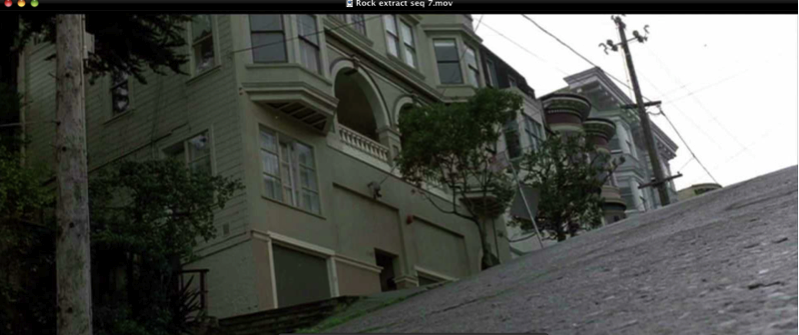
The Rock Assessment


NAMES: Laura and Rianna     Date: 19th October

1. 


The first shot is a mid shot, however in the background of the shot there is some action which makes the audience feel as if they are part of the action, as they are close to the action. This also allows the audience to see the character’s facial expressions.
2.


The camera is faced at a low angle shot, this gives the main character more power then the audience and gives the impression he is quite intimidating, due to the fact he is holding a gun. The camera is right in the action, almost attached to the person. This gives the impression that this character is very important because the camera is following him.


3.


The camera is positioned low down, this allows the audience to not only view the action of the men, it allows audience to recognise the Ferrari and indicates the car would be important in later scenes. The low angle shows how fast the car is when he drives off, this shows there is going to be a fast chase.
4.


The low angle whilst in the car gives Nicholas Cage authority as well as allowing the audience to see the frantic and anxious expression on his face. The camera then abruptly cuts to another car and person and the camera movements are extremely wobbly, almost handheld. This allows the audience to get extremely close to the action and intensity of the race. This is an overhead shot, which establishes the scene where the car is driving through. It then cuts back to the handheld style to get the audience back into the action again. This is further emphasised by the camera being attached to the car. Almost to give the audience a feel of what it is like to be in the car. The camera cuts and has a full on shot of the car that has recently smashed the shop: this is to surprise the audience to see that the car is still at the same speed. The camera returns to the handheld style in the car to make the audience feel as frantic as the driver. The next shot is a high angle shot, allowing the audience to be shocked by next crash into the taxi, before again returning to the shaky camera movement to engage the audience in the emotions of the driver.
5.


The camera is at a mid angle to show the audience just how fast the car is moving. The camera then does a very fast pan following the police car that crashes into the taxi. This also shows the speed the car is moving at.
6.


The camera is in the car giving the impression it is like a point of view shot. The camera is shaking as if it is handheld. The camera then cuts to an extreme close up of the driver in the car, this allows the audience to see the expressions on his face.

7.


The camera is at a low angle, which allows the audience to see the speed of the cars. It then cuts to an extreme close up of one of the characters and we see the anxious look on his face. The camera then is directly in front of the cars, which shows the audience the direct action. It then cuts back to the man in the car in a close up: the camera is shaking once again like it is handheld. The camera is once again at the low angle, to see how fast the cars are travelling, there is then a long shot allowing the action to pass the camera, and carry on into the distance. This shows the fast pace action.
8.


The camera is close up to the character, showing his expression, and shakes to mimic the movements of the car. It then cuts to the other character. This shows his frantic expression. Both their expressions looked stressed and angry.

Monday, 14 January 2013

Group Discussions 10/01/13

In the lesson today we conducted our audience research. We interviewed three students who were not media students and asked them a series of questions to do with their film habits, such as what genre of films do they watch the most, how many films on average they watch each week etc...
We videoed their responses and uploaded them onto the group blog. We also carried on planning our filming day, which is the 12/01/13. We finalized our cast members and decided on the most appropriate filming times. 


Titles Analysis


A title sequence is a method in both films and television programmes where the most important contributors to the film/programme is displayed, such as the title, cast members, key production members are presented. The title sequence is different from opening credits, which is where the most important members of the production are presented. 

Title sequences usually have music incorporated into them, but this is not always, this can depend on the genre, and type of opening sequence the film makers have wanted to create. Closing credits usually occur in very small print, which contrasts to the titles at the beginning of a sequence because the  writing usually stands out and is hard to avoid reading, especially when there is little action happening in the background, or there is a blank screen behind. 
There are different ways to display a title sequence at the beginning of a film. 

When films have a separate sequence altogether, it is known as a title sequence. One of the best examples of this is James Bond: Goldfinger (1964).

Today, titles are usually put on a black screen or on top of the action as it is happening. Below are various examples of different titles.


Friday, 11 January 2013

Lift and Stairs


Whilst editing the "Lift and Stairs" sequence it was important that I used match on action, which not only helped to create narrative, but it helped to create tension and suspense through various cutaways. I also used different tools on Final Cut to speed up time, in order to not lose interest.

Wednesday, 9 January 2013

Group Discussions 09/01/13

In today's lesson, we uploaded all of our information on and photos onto our group blog. We also decided that in the next lesson we would try to do some audience research.

Thursday, 27 December 2012

Narrative


Todorov's Theory

Todorov’s theory recognises the usual pattern for a storyline. This can often be applied to the vast majority of films.
One film which clearly complies with Todorov’s theory is “Singin’ in the Rain” (1952)
The beginning equilibrium is that the main character, Don Lockwood, is a silent movie star who can just tolerate his co-star, Lina Lamont, and they pretend, for publicity to be romantically involved. Their films are very successful, and are both very famous actors.
The disruption of the film is that “The Jazz Singer”, a film with sound, has been very successful so all film companies are now using sound in their movies.
The recognition is that there is success from sound films, so there is no option but to turn the next Lockwood and Lamont film into a “talkie”. The problem is that Lina’s voice is not seen as suitable for the sound.
The repair for the disruption is for Kathy, Don’s love interest to talk over Lina’s acting, so it sounds like Lina’s voice. However, the audience’s find out that it is Kathy’s voice not Lina’s and she is “the real star of the film”.
The new equilibrium is Don and Kathy to star in their sound film together, “Singin’ in the Rain”.

Levi Strauss' Theory

Another recognises theory is Levi Strauss’ theory, of there being binary opposition. This is clearly visible in Titanic (1997).
Some opposition are:
Rich vs. Poor: Rose’s family expect her to marry into her own class, not someone who is of a lower class.
Male vs. Female: There are clearly to main characters, and Rose is supposed to act like a typical “woman” of that era.
Good vs. Bad: Jack is a good man, and Rose’s true love, which is against Cal, who is a conman who does not want to be humiliated.

Propp's Theory

Propp’s theory relates to both characters and narrative.
He outlined the different roles in films, which is obvious in the film Bridesmaids (2011):
Hero= Annie
Villian= Helen
The Princess/Prize= Lillian, her best friend
The Donor= Rhodes
The Dispatcher= Helen
The Mentor= Annie’s mother

Bridesmaids also relates to Propp’s theory of narrative.
Preparation: Annie lives in Wisconsin, near to her best friend. She has a job and lives with two room mates.
Complication: Lillian is getting married and moving away. Helen, is Lillian’s good friend who makes Annie feel threatened. Annie meets a police officer, Rhodes, who she explains her troubles to.
Transference: Annie is given the chance to be maid of honour and on several occasions, ruins the plans for the wedding preparations.
Struggle: Lillian and Annie are now barely talking, she is forced to move in with her mother, who is helping her life get back on track, after losing her job. Annie is no longer speaking to Rhodes who had become her love interest, and on the day of the wedding Helen tells Annie that Lillian has gone missing.

Recognition: Rhodes helps Annie find Lillian. Lillian and Annie make up and Lillian gets married. Rhodes and Annie then make up and she is now happy to have her best friend back.

Saturday, 22 December 2012

Synopsis of Opening Sequence

Our opening sequence is in the thriller genre. The opening sequence starts with a young girl, around the age of 15-17 who is in her home. It then cuts to a man in his car, however we cannot see his face or what he is doing. We then realize he is stalking her, as there are lots of photos of her in different settings in his car. 
He has put cameras in his house to watch her, (which will be shown through the use of black and white), and is watching her whilst she relaxes in her home. We then hear someone ring the door bell, and she gets up to get the door. As she opens it, she says hello, with an over the shoulder shot, before it cuts to the title of the film.

Wednesday, 19 December 2012

Research into Similar Media Texts


As part of my research I looked at three opening sequences. In them, I examined various aspects of them.
The first opening sequence was Juno.
  • We immediately have an indication of genre is a “coming of age” film, as we are immediately introduced to the main character, a teenage girl. This is also indicated through her costume, as she wears jeans, a jumper and trainers, she looks very casually dressed.
  • During the title sequences Juno is seen walking down a street, with the rural location becoming a cartoon. This hints at the fact the main characters are young adolescents. This also indicates her state of mind whilst walking down the street as if she is daydreaming, before the setting soon becomes normal again, and she returns to reality. This also focuses the audience’s attention on Juno, that she is the main character.
  • The credits and text are bold as they are coloured in red, however it indicates and reflects youth, with a hint of immaturity, like the characters.
  • The music used in the title sequence is folk-style and is quite upbeat. It does not seem parallel with the mood that Juno has previously created, but fits well with the scene of her walking down the street.
  • There are many different camera angles used in this opening sequence, and starts with an establishing shot, to show the audience the main setting and location. There is also the use of close ups as Juno whispers in Paulie’s ear, which is used to build tension, as there is a prolonged pause between their speech. 
  • During this opening sequence, the titles comes after the establishing shot and the main introduction to the characters. It is not until Juno is walking down the street the main titles and credits occur. 
  • Mise en scene in this opening sequence: all characters are very casually dressed, indicatingthis is a normal day. The scene: the location, Juno's home, gives the impression that they live a very normal lifestyle, she does is not majorly wealthy.
  • The target audience for this film is indicated through the age of the main characters.
  • Women: are represented through Juno. She seems slightly immature, however the stereotypical female is not indicated through her clothing. Men are seen as being quite passive, however there is a male business owner.